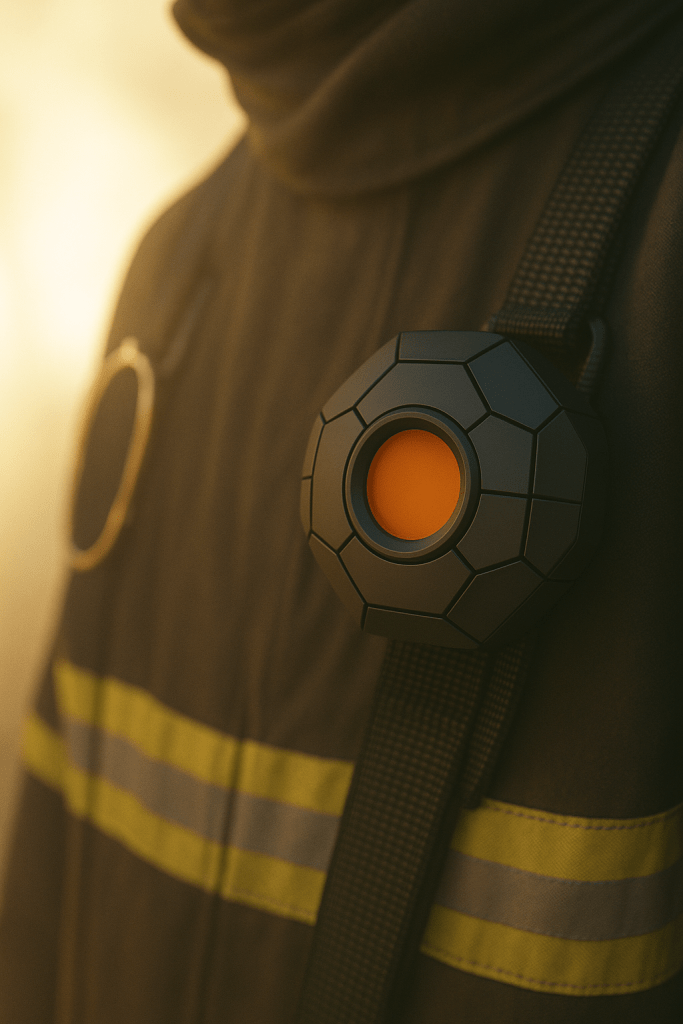
Firefighters still search burning buildings by hand.
FireSight finds people through smoke in seconds — using radar.
The Problem
Every structure fire starts a clock. Carbon monoxide reaches lethal concentrations in minutes. Hydrogen cyanide — off-gassed by the synthetic materials in modern construction — moves even faster. A trapped civilian’s survival window is measured in single-digit minutes.
The fire service knows this. They talk about it constantly. But the tools haven’t caught up.
Today, firefighters enter zero-visibility environments and search rooms on their hands and knees, sweeping by touch. Thermal imaging cameras help, but they require line-of-sight, get overwhelmed by flame signatures, and still need a firefighter in the room to use them.
That manual search process consumes 73–98% of the civilian survival window. The math hasn’t worked for a long time.
The Product
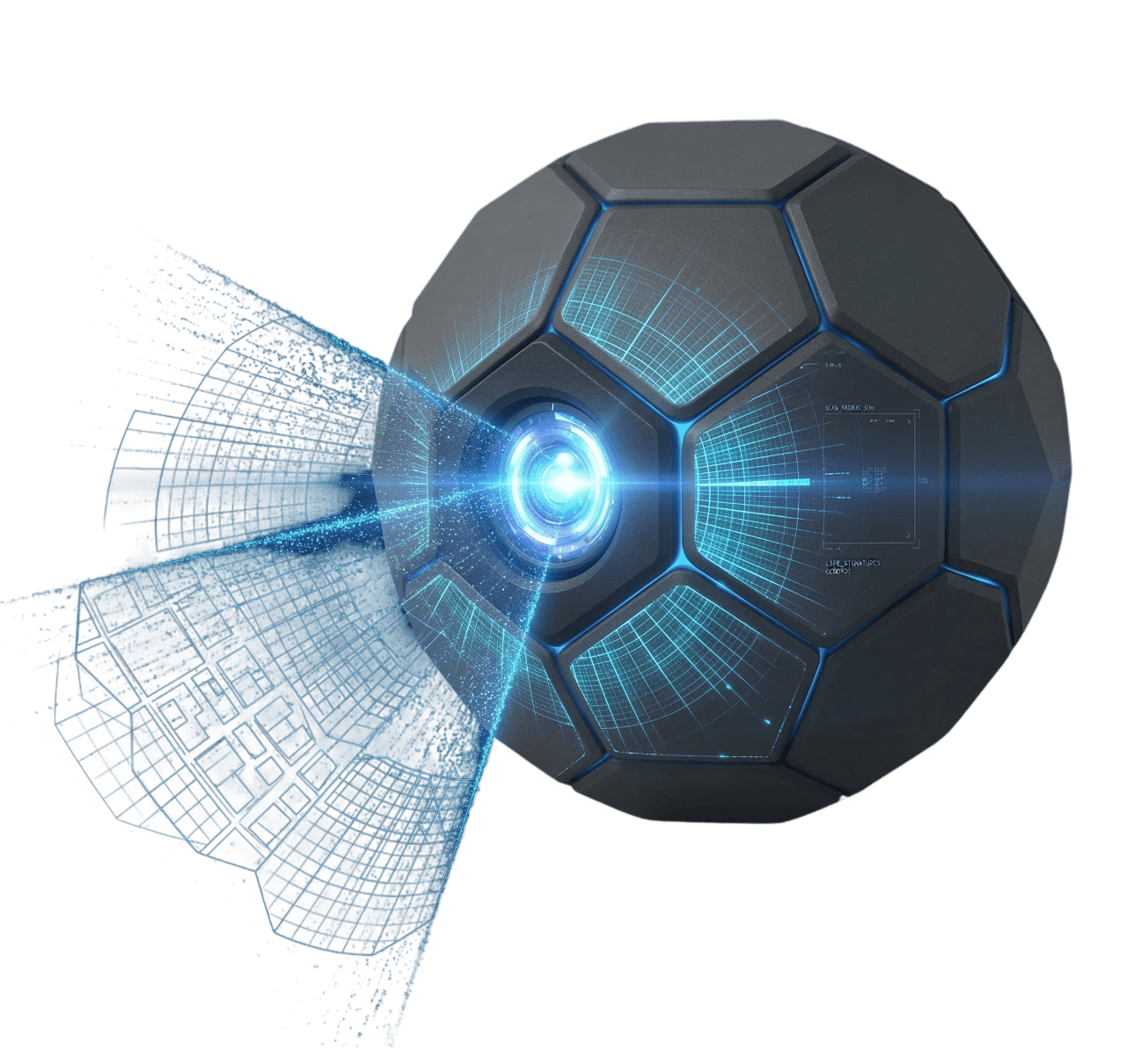
FireSight SCOUT is a throwable radar sphere — about the size of a softball — that detects human presence through dense smoke using 60 GHz mmWave radar.
Toss it through a doorway, a window, down a hallway. It scans autonomously and reports back what it finds — without requiring a dedicated operator. Detection ranges extend to 10 meters in optimal conditions, and the system is sensitive enough to detect bodies as small as 15 kg, including children and animals.
The SCOUT is built for fire. The enclosure is engineered from high-temperature-resistant materials to survive the conditions where it’s needed most. It wakes on impact, scans, and communicates findings wirelessly to personnel outside the hazard zone.
FireSight detection consumes roughly 6% of the survival window. Compare that to manual search. That’s the gap this product closes.

THE MARKET
FireSight serves two markets with the same core technology.
- Fire Departments — Over 29,000 departments in the U.S., facing a nationwide staffing crisis. Fewer firefighters per shift means fewer people to conduct manual searches, which means more risk per call. FireSight gives smaller crews a force multiplier they can deploy in seconds.
- Law Enforcement / SWAT — The same radar that sees through smoke also sees through common wall materials. Tactical teams need to know who’s inside a structure before making entry. FireSight SCOUT provides that intelligence from a throwable device — no setup, no operator, no delay.
The U.S. fire protection system market is valued at over $22 billion and growing at 7% annually.
Both markets are funded through established cooperative purchasing programs — HGACBuy, BuyBoard, TIPS/TAPS, Sourcewell — plus federal grant programs through DHS and DOJ. These aren’t customers who need to find new budget. The money is already allocated for equipment like this.

Why Now?
Three things are converging:
Modern building materials have compressed civilian survival times. Engineered lumber, open floor plans, and synthetic furnishings burn faster and produce more toxic gases than legacy construction. The survival window has shrunk, but fire department detection tools haven’t changed in decades.
The staffing crisis is real and getting worse. Departments are running fewer firefighters per apparatus, which makes manual room-by-room search slower and more dangerous on every call.
Defense tech investment is surging. Venture capital poured over $130 billion into defense technology startups since 2021. Autonomous detection and sensor fusion — the core of what FireSight does — sit at the center of where that capital is flowing.
FireSight is purpose-built for this moment: radar-based human detection, fire-hardened, throwable, autonomous, and accessible through purchasing channels departments already use.
IP Position
U.S. Patent Application No. 19/411,107, filed under USPTO Track One accelerated examination. Track One puts us on a fast path to issuance — expected allowance window mid-2026.
The patent covers the multi-sensor detection system, the throwable deployment configuration, and the fire-hardened enclosure design. Multiple claims have already been flagged by the examiner as containing allowable subject matter.
Why Phineas Laboratory?
Phineas Laboratory is a Service-Disabled Veteran-Owned Small Business (SDVOSB) based in Georgetown, Texas. SDVOSB certification is a real competitive advantage in government procurement — it opens doors to set-aside contracts across federal, state, and local agencies.
The team brings expertise in embedded systems, sensor fusion, and ruggedized hardware design. We build for environments that destroy consumer electronics.